How much CO₂ does a car produce?
About 2.3 kg of CO₂ for every litre of petrol it burns (8.9 kg a US gallon). For a typical car that's 150 to 250 g a km, or 250 to 400 g a mile.
Over a year it's about 4.6 tonnes for the average American car, and 1.7 to 2.2 tonnes in the UK, New Zealand and Australia, where cars go less far.
A year of driving, by country
The average car, the average distance, and what it costs to offset with native forest in each country.
| Country | A year | CO₂ a year | To offset |
|---|---|---|---|
| United States | 11,500 miles | 4.6 t | $208 |
| Australia | 12,100 km | 2.2 t | $131 |
| New Zealand | 11,000 km | 1.9 t | $154 |
| United Kingdom | 7,000 miles | 1.7 t | £59.33 |
| Canada | 15,200 km | 3.5 t | $210 |
Per km and per mile, by fuel economy
Petrol. Diesel puts out about 16% more for each litre, but diesel cars usually use fewer litres.
| L/100km | mpg (UK) | mpg (US) | g CO₂ a km | g CO₂ a mile |
|---|---|---|---|---|
| 4 | 71 | 59 | 92 | 149 |
| 5 | 56 | 47 | 116 | 186 |
| 6 | 47 | 39 | 139 | 223 |
| 7 | 40 | 34 | 162 | 260 |
| 8 | 35 | 29 | 185 | 297 |
| 10 | 28 | 24 | 231 | 372 |
| 12 | 24 | 20 | 277 | 446 |
| 15 | 19 | 16 | 347 | 558 |
Burning a litre of petrol makes 2.31 kg of CO₂, and a litre of diesel 2.68 kg. Official figures come from a lab; real driving is often 10 to 20% higher.
Electric cars
Nothing from the car itself. The electricity that charges it does, depending on the grid: at about 18 kWh per 100 km, charging losses included.
New Zealand
18 g/km
About 100 g a kWh: mostly hydro, geothermal and wind
United Kingdom
25 g/km
About 140 g a kWh: wind, gas and nuclear
United States
67 g/km
About 370 g a kWh: gas, coal and renewables
Australia
101 g/km
About 560 g a kWh: still heavy on coal
Grids change hour by hour and get cleaner every year; these are rough recent averages. Making a car, and especially its battery, has a footprint of its own that these leave out.
Questions
How much CO₂ does a car produce per mile?
About 250 to 400 grams for a typical petrol car: a 40 mpg (UK) car puts out about 260 g a mile, a 25 mpg (US) car about 350 g. The EPA uses 400 g a mile for the average US passenger vehicle.
How much CO₂ does a car produce per km?
Litres per 100 km times 23.1 for petrol (26.8 for diesel). A car using 7 L/100km puts out about 162 g/km; a small hybrid at 4.5 L/100km about 104 g/km.
How much CO₂ does a litre of petrol make?
About 2.31 kg; a litre of diesel about 2.68 kg. The carbon in the fuel joins oxygen from the air as it burns, which is why the CO₂ weighs more than the fuel. A US gallon of gasoline makes about 8.9 kg (19.6 lb).
How much CO₂ does a car produce in a year?
It depends on how far it goes. The EPA puts the average US car at about 4.6 tonnes a year. In the UK, New Zealand and Australia, where cars go less far, it's nearer 1.7 to 2.2 tonnes.
Do electric cars produce CO₂?
Not from the car. The electricity that charges them does, depending on how it's made: about 18 g/km on New Zealand's mostly renewable grid, around 100 g/km on Australia's coal-heavy one. That's still less than almost every petrol car.
How do I find my own car's CO₂?
In the UK, the CO₂ check finds it from the registration. Anywhere, the CO₂ calculator works it out from your fuel use and distance.
Your own car
Know what every drive puts out
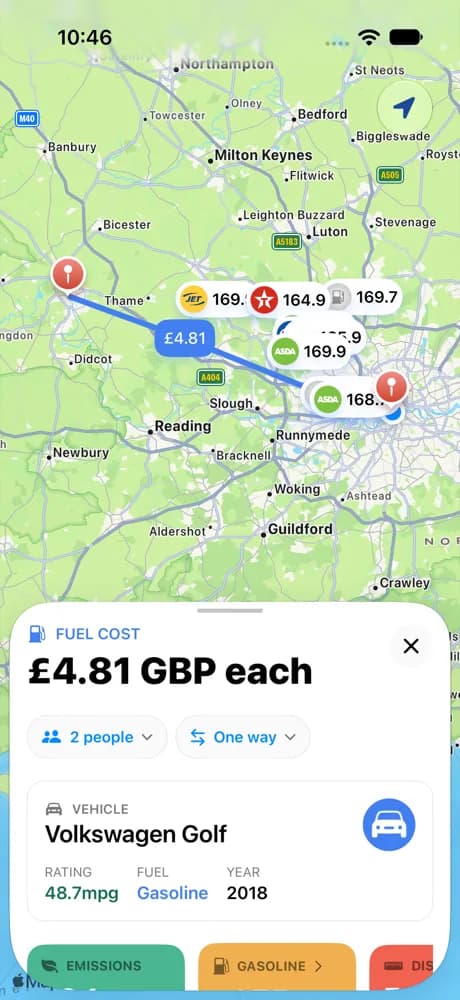
Roadtrip works out the fuel cost and the CO₂ of any drive in your exact car, so you can pick the cheaper, cleaner way to go.


Rated 4.7 by drivers · 700,000 downloads