Carbon offsetting for Australian drivers
What a drive, a road trip or a year in your car costs to offset in Australian dollars, and five ways to do it, from the cheapest credits to native bush.
A year of driving the average car in Australia
2.2 t CO₂
Offset with native bush in Australia: $131. Cheapest: $26.14.
Work out your ownFive ways to offset, cheapest first
The cheaper credits pay to stop emissions somewhere else. The dearer ones take carbon back out of the air, and the more they cost, the longer it stays out.
| Way to offset | How long it lasts | Price | A year of driving |
|---|---|---|---|
Renewable energy Helps fund wind and solar farms that replace coal power. | Avoids emissions, removes none | $12 a tonne | $26.14 |
Clean cookstoves Swaps smoky open fires for efficient stoves, so families breathe cleaner air. | Avoids emissions, removes none | $27 a tonne | $58.81 |
Native bush in AustraliaOur pick Plants and protects native trees that take in CO₂ as they grow. | Decades | $60 a tonne | $131 |
Biochar Turns crop waste into charcoal that locks carbon into the soil. | Centuries | $240 a tonne | $523 |
Direct air capture Machines pull CO₂ out of the air and turn it to stone underground. | 10,000+ years | $900 a tonne | $1,960 |
What a drive costs to offset
For the average car in Australia. A bigger or thirstier car puts out more; an electric one far less.
| Drive | CO₂ | Renewable energy | Native bush in Australia | Direct air capture |
|---|---|---|---|---|
| 100 km | 18.0 kg | $1.00 | $1.08 | $16.20 |
| A 1,000 km road trip | 180 kg | $2.16 | $10.80 | $162 |
| A year (12,100 km) | 2.2 t | $26.14 | $131 | $1,960 |
Small amounts are rounded up to a $1 minimum, which covers more CO₂ than the drive.
Avoid, then remove
Offsets come in two kinds. Avoidance credits pay for something that stops CO₂ being made somewhere else: a wind farm instead of a coal plant, a clean stove instead of an open fire. They're cheap, and the carbon you put out stays in the air.
Removal credits take CO₂ back out of the air. Trees do it for decades, biochar for centuries, and direct air capture turns it to stone for thousands of years. They cost more, and they're the only way to undo a drive rather than make up for it.
The cheapest offset of all is the drive you don't make, and the next is a more efficient car. Offsetting is for what's left.
Carbon credits in Australia
Australia's own carbon credits are Australian Carbon Credit Units (ACCUs), issued by the Clean Energy Regulator. Each is a tonne of CO₂ kept out of or taken from the air by a registered project: native bush regrowing on farmland, plantings, or cooler early-season burns across the savanna.
Native bush credits take carbon in as the trees grow back, over decades, and come with homes for wildlife and shade for farms. They cost more than credits from overseas, and you can see where they are.
A business that wants to call a product or its fleet carbon neutral can be certified under Climate Active, the government's scheme, which sets which credits count.
Questions
How much does it cost to offset a car in Australia?
An average car in Australia driven 12,100 km a year puts out about 2.2 t of CO₂. Offsetting that costs $26.14 a year with renewable energy credits, $131 with native bush in Australia, and $1,960 with direct air capture.
What is a carbon offset?
A carbon offset pays for a tonne of CO₂ to be kept out of the air, or taken out of it, somewhere else, to make up for a tonne you put in. Each one is a credit, checked by a registry and retired in your name once it's used, so it can't be sold twice.
Do carbon offsets work?
The good ones do what they say, but they're not all equal. Credits that avoid emissions (renewable energy, cookstoves) are cheap, and how much they really change is debated. Removals (forest, biochar, direct air capture) take carbon out of the air and are easier to trust, and the longer they lock it away, the more they cost. Driving less and in a more efficient car comes first; offsetting covers what's left.
Carbon offset or carbon credit: what's the difference?
A carbon credit is the certificate for a tonne of CO₂ avoided or removed. It becomes your offset when it's retired against your own emissions.
How many trees would offset my car?
A grown tree takes in roughly 22 kg of CO₂ a year, so a year of driving an average car needs about 75 to 210 trees growing for that year, depending on the car and how far it goes. Young trees take in far less, which is why forest credits are sold by the tonne, not the tree.
How much does it cost to offset a tonne of CO₂?
From $12 a tonne for renewable energy credits to $900 a tonne for direct air capture. Native forest, the middle of the range, is $60 a tonne.
What is an ACCU?
An Australian Carbon Credit Unit: one tonne of CO₂ avoided or removed by a project registered with the Clean Energy Regulator. They're traded by businesses and the government, and can be retired to offset emissions.
More on your car's CO₂
Know what every drive puts out
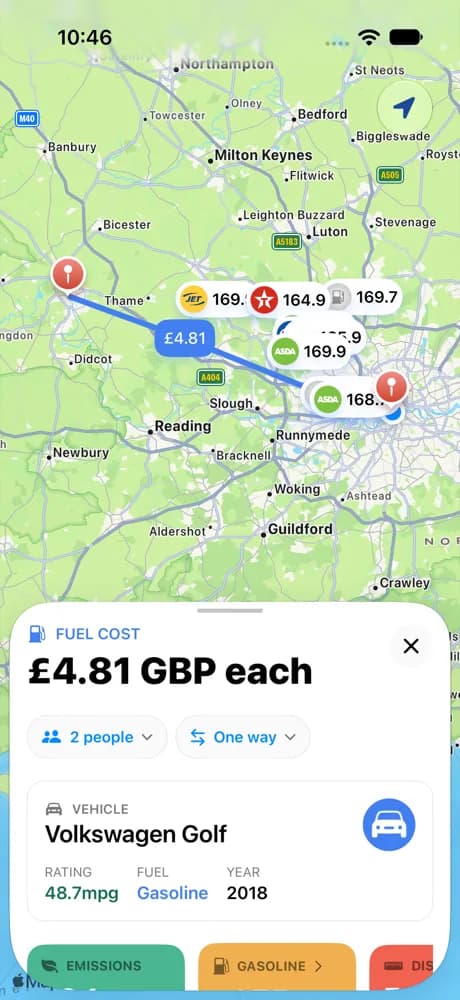
Roadtrip works out the fuel cost and the CO₂ of any drive in your exact car, so you can pick the cheaper, cleaner way to go.


Rated 4.7 by drivers · 700,000 downloads